

AI-Generated Biblical Angels: Reimagining Christian Angel Imagery Through Artificial Intelligence

by Shalwa
Angels have appeared in Christian art for over two millennia — from glowing Renaissance messengers to awe-inspiring beings described in Revelation. Yet, the Biblical text itself paints angels as far more complex: multi-winged, radiant, and often terrifying embodiments of divine presence.
With the rise of AI image generators like ArtSmart, Midjourney, and Stable Diffusion, artists are reimagining these celestial figures through data-driven creativity. What once took oil on canvas can now emerge from text prompts — transforming ancient vision into digital form.
This article explores how AI interprets Christian Biblical angels, how to craft authentic visual prompts, and what artistic and ethical boundaries to consider when digitizing sacred imagery.
to content ↑Understanding Angels in Christian Visual Tradition
Before diving into prompt design or model behavior, it’s vital to understand how angels are described and represented in Christian contexts. In Christian tradition, angels are not just symbolic figures — they serve as messengers, protectors, and manifestations of divine order. Over centuries, artists have interpreted them through theology, art, and imagination, blending scriptural accuracy with human emotion.
For AI image generation, understanding these origins helps ensure that digital angels feel authentic, not generic. When you know how Christian texts describe their form, purpose, and hierarchy, you can guide the AI to recreate their essence — not just their appearance — with the right symbolism, light, and posture.
The Biblical Descriptions: From Messengers to Multiform Beings
In Scripture, angels appear as both divine messengers and manifestations of God’s glory. AI models trained on visual datasets often default to soft, humanlike figures — but the Bible’s depictions are dramatically different.
Common Angelic Forms in the Bible
- Seraphim (Isaiah 6:2–3): Six-winged beings who cry “Holy, holy, holy,” often associated with fire and purity.
- Cherubim (Ezekiel 10, Genesis 3:24): Guardian beings with multiple faces — lion, ox, eagle, and human — symbolizing divine strength and wisdom.
- Archangels (1 Thessalonians 4:16, Jude 1:9): Messengers and warriors such as Michael and Gabriel.
- Heavenly Hosts (Luke 2:13–14): Multitudes of angels described as radiant and harmonious, surrounding divine light.
Each of these forms presents a different visual challenge for AI: how to balance symbolism, beauty, and the surreal imagery of ancient text.
to content ↑How AI Interprets Angelic Imagery
AI models don’t understand theology — they interpret patterns and associations in data. When you prompt “Biblical angel,” the model searches its training data for visual correlations between “angel,” “Bible,” and “religious art.”
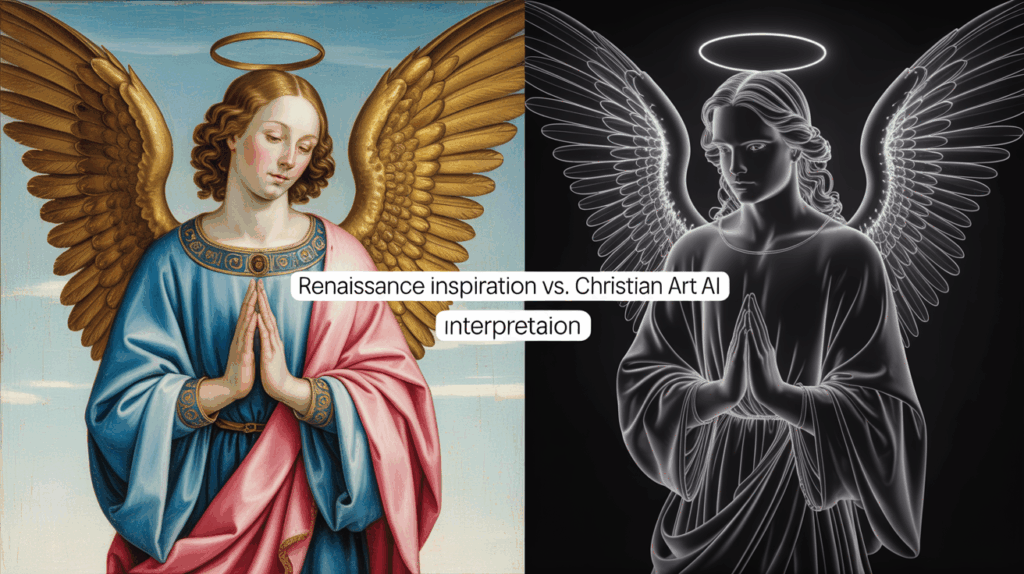
The Source Bias: Classical Art vs. Literal Scripture
AI image generators learn from the data they’re trained on — and most of that data reflects centuries of artistic interpretation, not direct scripture. When you ask an AI to generate “a biblical angel,” it draws from paintings, films, and illustrations rather than theology. This creates a subtle source bias — the angel you see is more Michelangelo than the Book of Ezekiel.

That’s why most models tend to reproduce:
- Renaissance-inspired angels — elegant, human-like figures with perfect symmetry, soft lighting, and feathered wings. These reflect the Western artistic ideal of divine beauty more than literal biblical descriptions.
- Modern fantasy versions — stylized, glowing entities or armored celestial warriors resembling video game or cinematic characters.
For creators, recognizing this bias is crucial. It doesn’t mean the outputs are wrong — it just means they’re influenced. To generate authentic Christian angels using AI, you need to guide the model beyond these defaults — toward depictions inspired by scripture’s tone, symbolism, and narrative context rather than inherited aesthetics.
to content ↑Prompt Design: Translating Scripture into Visual Language
Designing prompts for AI-generated Christian angels isn’t about quoting verses — it’s about translating scripture’s symbolism into visual cues the model can interpret. Scripture describes angels with poetic and metaphorical language — “radiant,” “wings full of eyes,” “burning like bronze,” or “clothed in light.” AI doesn’t understand theology, but it does understand imagery, texture, and form.
So your task is to act as a creative translator: turn those metaphors into descriptive visuals. For example, instead of quoting Ezekiel directly, describe “a radiant six-winged figure surrounded by glowing light and wheels of fire, rendered in golden illumination.”
This bridges sacred imagery and technical precision — helping the AI grasp what you mean without drifting into fantasy aesthetics or abstract chaos. The best results come when you balance faithfulness to scripture with artistic direction that AI can visualize clearly, producing images that feel reverent, powerful, and visually coherent.
How to Structure Effective Prompts
A well-built prompt acts like a director’s script — guiding the model through what to depict, how to style it, and from what point of view to show it. Without structure, even the most poetic idea can become visually chaotic. For angelic imagery in a Christian context, you’re not just generating fantasy art — you’re aiming for reverence, symbolism, and harmony. That means grounding your description in clarity, light, and purpose rather than just spectacle.
Use a three-part structure:
- Subject description — e.g., “Six-winged Seraphim with radiant light.”
- Artistic tone or lighting — e.g., “Cinematic lighting, divine radiance, golden atmosphere.”
- Composition or perspective — e.g., “Wide-angle heavenly scene, surrounded by glowing clouds.”
Examples of Prompts for Different Angel Types
1. Seraphim (Isaiah 6)
“A six-winged Seraphim floating above an altar, radiant golden light, fire and smoke surrounding, cinematic tone, detailed feathers, ethereal glow — inspired by the Book of Isaiah.”
2. Cherubim (Ezekiel 10)
“A divine guardian with four faces — human, lion, ox, and eagle — surrounded by wheels of light and eyes, glowing metallic textures, surreal holy energy, Biblical realism.”
3. Archangel Michael (Revelation 12)
“Archangel Michael in shining armor, wielding a divine sword, surrounded by radiant light and clouds, classical Christian art style, Rembrandt-inspired lighting.”
Avoiding Over-Stylization
AI can exaggerate color and emotion, creating images that feel too fantasy-like.
To maintain reverence and realism:
- Avoid terms like “angelic warrior” or “epic fantasy.”
- Use “Biblical,” “Christian art,” “celestial,” or “divine messenger” for balance.
- Tone down lighting with phrases like “soft glow” or “natural divine light.”
Challenges in Depicting Biblical Accuracy with AI
AI excels at producing stunning, realistic visuals — but that realism often comes at the cost of symbolic integrity. In Christian theology, angels aren’t just “beautiful beings with wings”; they represent divine order, mystery, and the unseen hierarchy of heaven.
However, because most AI models are trained on pop culture and classical art, they default to overly humanized depictions — flawless faces, soft feathers, glowing halos. The true challenge lies in balancing reverence with realism: keeping the divine essence without making the image feel like a fantasy game illustration. Achieving this requires careful prompt phrasing, aesthetic restraint, and an understanding that Christian angels are meant to evoke wonder, not perfection.
1. Anatomical Complexity
Christian angelic hierarchies such as Seraphim and Cherubim are described in ways that defy human proportion — six wings, multiple faces, and layered symmetry. This makes them a challenge for AI models that default to human anatomy. The result is often distorted limbs or mismatched wings.
- Seraphim and Cherubim descriptions defy normal symmetry.
- AI models trained on human anatomy often distort wings or faces when generating multi-winged forms.
💡 Solution: Emphasize geometry and abstraction — e.g., “structured symmetry,” “divine geometry,” or “patterned celestial form.”
These cues tell the AI to think in forms and patterns rather than bodies.
2. Lighting and Atmosphere
In scripture, angels emit their own divine radiance rather than being lit from an outside source. Yet AI tends to render them as cinematic characters under studio lighting, with exaggerated glow or lens flare.
- Scriptural angels are often described as radiant, not illuminated by external light.
- AI tends to overuse “glow” or “lens flare.”
💡 Solution: Use terms like “internal divine light,” “radiant aura,” or “holy luminosity.”
3. Symbolic Integrity
While halos and white robes are iconic, they’re artistic inventions rather than Biblical descriptions. Christian scripture speaks of flame, presence, and glory — not costume or ornament.
- Halos, swords, or white robes are cultural, not strictly Biblical.
- To match Christian scripture, prioritize phrases like “burning presence,” “throne-room light,” or “voice of many waters.”
💡 Solution: Use phrases like “burning presence,” “throne-room light,” or “voice of many waters.” These evoke the awe and symbolism of Christian theology without relying on cultural clichés.
to content ↑Artistic Ethics: Respecting Sacred Imagery in AI Art
Religious imagery, especially that of angels, holds deep spiritual meaning for millions of people. Using AI to reinterpret it should be done with care, reverence, and cultural awareness rather than for shock or trend value. AI art can beautifully modernize Biblical concepts, but it must do so in a way that honors the sacred origins behind them.
Ethical Considerations
To ensure your work remains respectful and authentic:
- Avoid depicting God or Christ directly — focus instead on angels, symbolism, and light, which embody divine presence without personifying it.
- Refrain from distortion or parody that might appear to mock scripture or religious iconography.
- Be transparent: include clear disclaimers like “AI-generated artistic interpretation inspired by Biblical descriptions.” This maintains honesty while acknowledging creative reinterpretation.
Cultural Context
Christian angels aren’t fantasy creatures — they are sacred messengers representing purity, hierarchy, and divine order. When you generate them through AI, think of your work as part of a visual dialogue between faith and technology. Done thoughtfully, it can renew appreciation for ancient imagery and show how digital art can coexist with tradition rather than replace it.
to content ↑The Visual Evolution: From Renaissance Paintings to AI Imagery
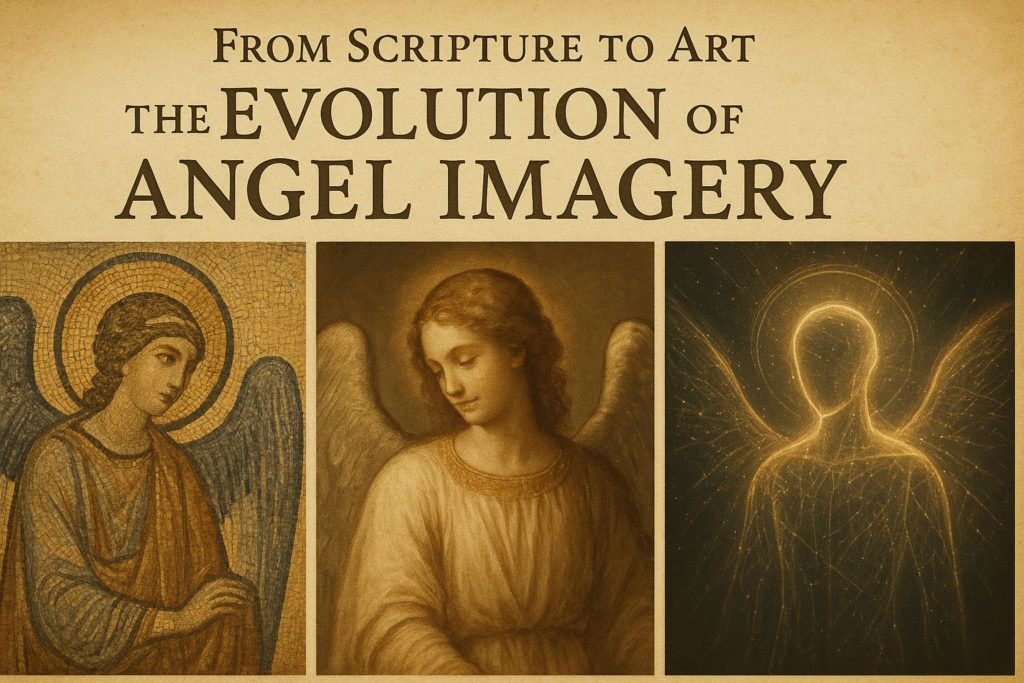
Art has always shaped how people imagine the divine. The way angels appear in paintings and media reflects not just theology but also the aesthetics and technology of each era. From hand-painted frescoes to diffusion-based AI renderings, every generation reinterprets what the “heavenly” looks like through its own creative lens. Today, AI continues that lineage — not by replacing art history, but by remixing it into something entirely new and interactive.
Renaissance Influence
During the Renaissance, artists like Raphael, Michelangelo, and Botticelli defined the ideal angelic form — serene, perfectly human, and balanced in composition. Their angels reflected human beauty elevated by divine light. This period set the foundation for how AI models interpret “angel” today: graceful figures, soft skin tones, golden light, and symmetrical wings.
- AI example prompt: “Renaissance-inspired angel, painted style, soft chiaroscuro lighting, divine harmony, Raphael-style composition.”
- These cues tap into datasets rich in classical art, giving your generated angel the same warmth and realism seen in 15th-century paintings.
Baroque & Romantic Eras
As art evolved, so did the emotional depth of angels. The Baroque and Romantic painters — such as Rembrandt, Caravaggio, and William Blake — emphasized movement, contrast, and feeling. Angels became radiant messengers emerging from shadows, symbols of divine drama. This period introduced cinematic light and dynamic composition, which directly influence AI-generated visuals today.
- AI example prompt: “Baroque angel with chiaroscuro lighting, emotional realism, heavenly glow emerging from darkness.”
- These elements help create intensity, emphasizing spiritual awe rather than simple beauty.
AI’s New Role
AI imagery now blends all of these historical aesthetics — merging centuries of artistic evolution into a single digital canvas. A single prompt can combine:
- Renaissance anatomy for balance and form
- Baroque lighting for depth and drama
- Modern surrealism for abstraction and symbolic tone
AI becomes the new bridge between tradition and experimentation. For instance:
- Prompt example: “AI-generated sacred art, fusion of Renaissance realism and Baroque lighting, ethereal atmosphere, surreal divine symbolism.”
- This produces an image that feels timeless — both historically grounded and imaginatively futuristic.
By referencing artistic styles directly within your prompts (“Biblical realism,” “Baroque chiaroscuro,” “neo-classical divine portrait”), you help AI connect modern output with centuries of visual storytelling — continuing humanity’s quest to visualize the unseen.
Future of Christian Angel Imagery in AI
AI generation is entering an era of spiritual symbolism and aesthetic realism. Soon, models will understand narrative context — producing angels that reflect not only scripture but mood, era, and theological symbolism.
This opens doors for:
- Digital storytelling – AI-assisted Biblical visualizations.
- Church media & education – Visual sermons, illustrated gospels.
- Fine art and NFTs – Reinterpreting divine imagery for modern collectors.
AI won’t replace sacred art — it’s simply the next medium in a 2,000-year tradition of depicting heaven through human imagination.
to content ↑Conclusion
AI-generated Biblical angels show that technology can translate sacred imagery into modern expression — not to imitate belief, but to celebrate beauty, symbolism, and history.
For Christian-inspired artists, understanding how to balance visual reverence and creative interpretation is the key to producing work that feels both spiritual and respectful.
From the fire-lit Seraphim to the triumphant Michael, each angel rendered through AI becomes a dialogue between text and technology — proof that the divine can still inspire the digital.
FAQs: AI-Generated Christian Angels
1. Are AI-generated angels considered religious art?
They can be, depending on intent. If created respectfully and inspired by scripture or Christian symbolism, AI angel art fits within the tradition of religious visual interpretation.
2. Can I use AI-generated angel images for church or ministry projects?
Yes — many churches use AI visuals for slides, worship media, and storytelling, as long as they align with the message and are clearly credited as AI-generated.
3. What’s the difference between “Biblical” and “fantasy” angel prompts?
“Biblical” prompts focus on scriptural descriptions and symbolism, while “fantasy” prompts rely on cultural aesthetics like armor or cinematic wings.
4. How can I make AI angels look more authentic to scripture?
Reference specific verses (like Isaiah 6 or Ezekiel 10) in your prompt, and use terms such as “divine geometry,” “radiant aura,” or “holy presence” to maintain reverence and structure.
5. Which AI image generators work best for Christian-themed art?
Tools like ArtSmart, Midjourney, and Stable Diffusion perform well because they allow precise control over lighting, tone, and symbolism.
6. How do I avoid creating images that might offend religious viewers?
Avoid depicting divine figures directly (like God or Christ) and refrain from satirical or distorted portrayals. Always include context or disclaimers when sharing publicly.
7. Can AI generate angels with accurate Biblical features like multiple wings or faces?
Yes, but results vary. To improve accuracy, describe structure clearly — “six wings arranged symmetrically, glowing inner light, no human face” — and avoid overly humanizing terms.
8. Do AI models understand the difference between Christian and non-Christian angels?
Not inherently. AI recognizes visual patterns, not theology. You must guide the model using faith-specific terms like “Christian art,” “Biblical symbolism,” or “sacred light.”
9. Can AI help modern artists reinterpret traditional angel paintings?
Absolutely. AI allows blending of styles — for instance, combining Renaissance realism with surreal lighting — to modernize sacred art without losing its essence.
10. Is it ethical to sell AI-generated angel art?
Yes, if it’s presented as an artistic interpretation rather than sacred depiction. Include a note like “AI-generated artwork inspired by Christian scripture” to maintain transparency.
Sources: